

Google AI Overviews are generated answer cards Google may place at the top of some search results. They summarize an answer in Google's words and show links to a handful of sources the system relied on. They are not the same as a featured snippet block or a People Also Ask row: overviews are broader summaries, they appear only on some queries, and the set of cited URLs can differ from the classic top ten.
You cannot enroll your site or pay for placement. What you can do is publish pages that are easy to crawl, easy to quote, and factually solid—then check whether your URLs show up when overviews appear for the questions you care about.
This guide covers how overviews show up in the SERP, what tends to help citations (without guaranteed formulas), honest limits, and where the AI Overview Checker fits when you want a structured pass on a URL you control.
How AI Overviews appear (and when they do not)
Overviews are query-dependent. Informational questions—definitions, how-to steps, comparisons—trigger them more often than branded navigational searches. Google may also skip an overview if it lacks confidence, if the topic is sensitive, or if the SERP already satisfies the user with traditional results.
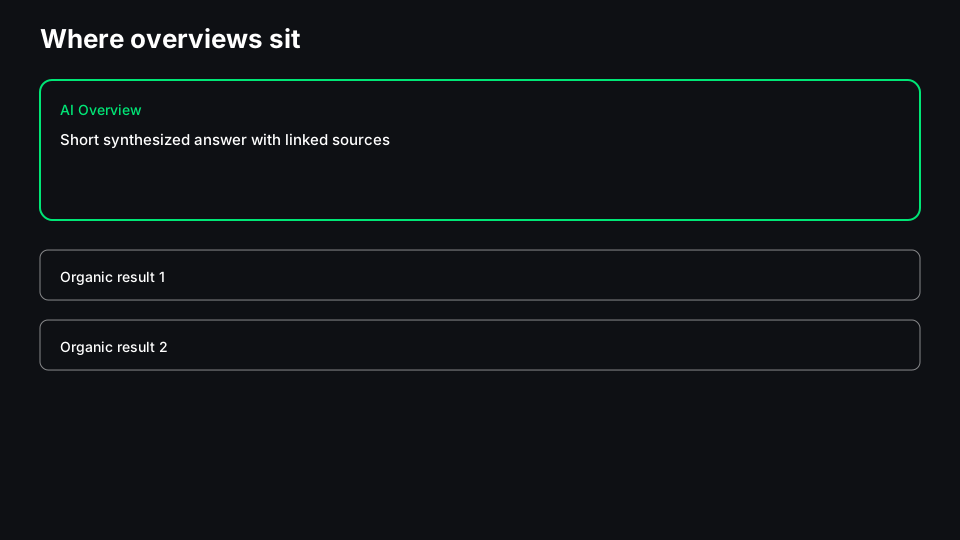
Visually, you will usually see:
- A labeled AI-generated block with a short multi-sentence answer.
- Source chips or links to specific pages, not always in the same order as organic rankings.
- Standard results below, sometimes with other SERP features still present.
Overviews can change between accounts, locations, and time. Treat any single screenshot as a snapshot, not a contract.
What "citation" means here
A citation in an AI Overview is a link-out to your page because Google's system used content from that URL in the summary. It is not a traditional ranking position. A page can be cited while ranking fifth—or not cited while ranking first—if another URL has a cleaner passage for the generated answer.
Citations are useful for visibility and trust, not a predictable traffic line item. Some searchers read the overview and never click. Others click sources to verify facts or go deeper. Optimize for being a credible source, not for gaming a black box.

What helps your content get cited
Google has not published a step-by-step citation checklist. Practitioners who read overview sources regularly see patterns:
Answer-first structure
Put the direct answer in the first one or two sentences under a heading that matches the question. "What is a canonical tag?" should be answered immediately, not after three paragraphs of history.
Use one main question per section. Mixed topics produce muddy passages models skip.
Headings that match real searches
H2/H3 text written like people search ("How long does a 301 take to work?") gives models anchors. Cute magazine headlines do not.
Lists, tables, and defined terms
Steps belong in ordered lists. Comparisons belong in tables. Definitions belong in a tight paragraph before elaboration. Match the shape the question implies.
Crawlability and indexability
An overview cannot cite what Google cannot fetch. Pages blocked by robots.txt, noindex, or soft 404s are non-starters. Fix technical gates before rewriting prose.
Topical depth on the same site
Thin pages that barely define a term lose to sites that cover the topic thoroughly. You do not need fluff— you need complete answers on the URL you want cited, with internal links to related depth.
Schema that reflects visible content
Article, HowTo, and accurate FAQPage markup describe what is already on the page. They are not levers that force overview inclusion. Misleading schema is worse than none. Add types that truthfully match the body.
E-E-A-T signals you control
Clear author or brand attribution, updated dates on guides that change, citations to primary sources, and pages that do not contradict your other URLs all reduce the chance Google prefers someone else.
Honest limits you cannot control
- Eligibility is Google's call. Competitors may get an overview on a query where you never appear, even with better content.
- Passage selection is opaque. Minor edits can remove a citation without warning.
- SERP tests are noisy. Personalization and location shift what you see in a browser.
- Robots tokens are not a full AI strategy. Blocking training bots does not replace good content for search users.
- No tool sees Google's private overview model. Checkers and SERP scrapes show public signals and whether an overview appeared in a given check—not a guaranteed forecast.
Practical workflow on a URL you care about
- Pick five to ten real questions your page should answer. Use Search Console queries, customer support tickets, or sales calls—not only volume tools.
- Search each question logged out. Note whether an overview appears and which domains are linked.
- Rewrite sections so each question has an answer-first block. Cut intros that delay the point.
- Confirm crawl and index signals on the URL (status, robots, canonical, noindex).
- Add schema only where it matches visible Q&A or article content.
- Re-test after publish over a few weeks. Overview citations lag indexing.
When you want a single URL scored for overview-friendly structure—headings, snippet-like paragraphs, schema presence—the AI Overview Checker on Scrawl runs those checks from a live fetch. It does not query Google on your behalf or promise placement; it highlights gaps you can fix before you wait on SERP luck.
What not to do
- Paste AI-generated filler to hit word count. Overviews favor clarity, not length.
- Copy a competitor's overview text. You need a better passage, not a paraphrase of Google's summary.
- Stuff keywords into headings until they stop reading like questions.
- Rely on FAQ schema alone while the visible page hides answers in tabs or JavaScript-only widgets.
- Treat one winning screenshot as permanent. Keep monitoring target queries.
How this relates to other SERP features
Featured snippets lift one passage into a small box. People Also Ask expands question rows with short answers. AI Overviews synthesize across sources. Writing answer-first sections helps all three, but none share a single guaranteed trigger. The overlap is good writing and clean HTML—not a separate content type for each feature.
If you already optimize for PAA-style questions, you are most of the way toward overview-friendly pages. The extra step is making sure each answer is self-contained enough to survive in a generated summary that blends multiple sites.
Measuring success without fake metrics
Track referral queries in Search Console where URLs gain impressions after you rewrite. Watch click-through on pages you expect to be cited—not overview share, which Google does not break out cleanly for most sites. Qualitative checks matter: search your key questions monthly and note whether your domain appears in the source list.
AI Overviews are part of search, not a replacement for it. Build pages that deserve to be quoted, keep them technically sound, and use tools to catch structural gaps early. The rest is persistence and accurate copy—not shortcuts.
Quick reference before you publish
| Check | Why it matters for overviews |
|-------|------------------------------|
| Crawl allowed | Blocked URLs never become sources |
| Question-style H2/H3 | Models anchor on the wording searchers use |
| Answer in sentence one | Quotable passages stay short |
| Visible list or table | Matches how-to and comparison queries |
| Honest schema | Describes what users already see on the page |
| Updated date on living guides | Signals maintenance on topics that change |
Run through the table on one priority URL, fix what is red, then move on. Overview citations are a lagging indicator; technical mistakes are a leading one you can clear today.